
Small Business SEO Services That Help You Reach More Customers
Running a small business means making the most of your time, budget and resources. You may offer excellent services, have a professional website and look after your customers well, yet still struggle to attract enquiries from Google.
That is where a practical SEO strategy can help.
At SEOShine, I focus on improving the parts of your website and online presence that can help potential customers find, understand and contact your business. My approach combines keyword research, on-page SEO, technical SEO, local search optimization and useful website content based on your business goals.
Whether you serve customers in the United States, the United Kingdom or Canada, the aim is to build a stronger search presence that supports sustainable business growth.
Want to understand what may be holding your website back? “Contact SEOShine for an SEO consultation”
What Is Small Business SEO?
Small business SEO is the process of improving your website and online presence so that your business can appear for relevant searches on Google and other search engines.
It involves more than adding keywords to a page. Search engines need to understand what your business offers, which customers you serve, how your website is structured and whether your content answers the searcher’s needs.
A small business SEO strategy may include:
Researching keywords that match your services and customer intent.
Improving page titles, headings, content and internal links.
Fixing technical issues that affect crawling, indexing and usability.
Optimizing your Google Business Profile when local search is relevant.
Creating useful service pages that answer customers’ questions.
Improving your website’s credibility through relevant, legitimate mentions and links.
- Monitoring organic traffic, enquiries and conversions.
The right priorities depend on your industry, location, competition, website condition and available resources.
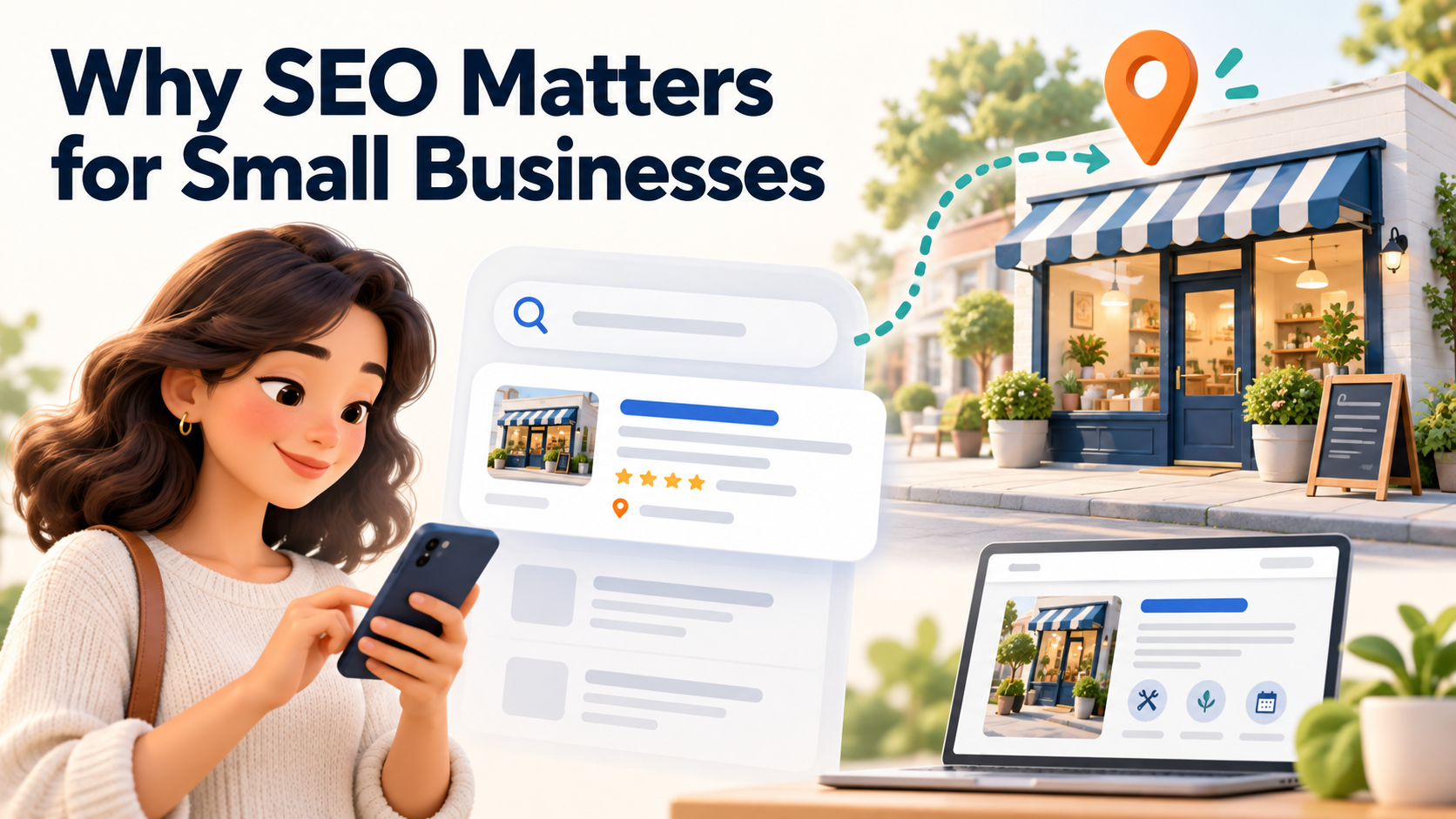
Why Does SEO Matter for Small Businesses?
Potential customers often research a service before contacting a business. If your website does not appear for relevant searches, people may discover competitors instead.
SEO helps you build visibility for the searches that matter to your business.
Reach people who are actively looking for your services
Someone searching for a specific service in their area may already be considering their options. Creating a useful page for that service can help your business become part of their decision-making process.
Build a stronger online presence
Consistent business information, helpful content, clear service pages and a technically accessible website help people understand what you offer.
Make better use of your marketing budget
Organic search can become a valuable source of relevant visitors over time. However, results are not guaranteed, and SEO requires ongoing work, monitoring and investment.
Turn relevant website visits into enquiries
Traffic alone does not tell the whole story. Visitors need clear service information, visible contact options, a usable mobile experience and reasons to trust your business.
The objective is not simply to attract more visitors. It is to attract the right visitors and make it easier for them to take the next step.
My Small Business SEO Services
Every business has different needs. I prioritize SEO tasks according to your website’s current condition, search opportunities and business objectives rather than applying the same checklist to every project.
Small Business SEO Audit
Before deciding what to change, I review the website to identify issues and opportunities.
An SEO audit may cover:
Indexing and crawlability.
Page titles and meta descriptions.
Heading structure and content quality
Broken links and redirect issues.
Internal linking and website architecture.
Mobile usability and page performance.
Relevant keyword targeting.
- Competitor search visibility.
Local SEO signals, where applicable.
The outcome is a prioritized action plan that explains what needs attention, why it matters and which improvements should be considered first.
Keyword Research and Search Intent
Effective keyword research starts with understanding your customers, not simply choosing phrases with high search volume.
I look for relevant searches that indicate what people need, what services they are comparing and whether they may be ready to contact a provider.
For example, a local service business might target a core service page around a relevant service keyword, while a supporting article answers questions about cost, process or common problems.
The research helps guide page targeting, content structure and internal links while avoiding unnecessary duplication between pages.
On-Page SEO
Your important pages should clearly communicate what your business does and how it helps customers.
On-page SEO may include:
Writing descriptive page titles and meta descriptions.
Improving H1 and H2 headings.
- Matching content to search intent.
- Organizing service information logically.
Adding useful internal links.
Improving image descriptions and alternative text.
Making calls to action easy to find.
I focus on making pages clearer for both visitors and search engines without forcing keywords into every paragraph.
Technical SEO
A website may contain useful content but still have technical problems that make it difficult to crawl, index or use.
Technical SEO focuses on identifying and addressing issues that affect search accessibility and website performance.
Depending on the audit findings, work may include:
Checking robots.txt and XML sitemaps.
Reviewing indexing and canonical signals.
Identifying broken links and redirect chains.
Improving internal website structure.
Reviewing mobile usability and Core Web Vitals.
Checking structured data where appropriate.
Investigating duplicate or thin pages.
Not every website needs every technical change. Recommendations should be based on evidence and the actual condition of the site.
Local SEO for Small Businesses
If your business serves a particular city, town or service area, local SEO can help potential customers discover your services through relevant local searches.
The strategy may include:
Researching service and location keywords.
Improving location-relevant service pages.
Optimizing your Google Business Profile where eligible.
Reviewing business name, address and phone consistency.
Identifying relevant local directories.
- Supporting genuine customer reviews.
Improving the connection between your website and local business information.
Local SEO should reflect where your business genuinely operates. Creating repetitive location pages without meaningful local value is not a sustainable strategy.
Google Business Profile Optimization
For eligible businesses that meet Google’s requirements, a well-maintained Google Business Profile can support visibility in Google Search and Maps.
I can review important profile elements, including business categories, services, contact details, website links, opening hours, business descriptions and review management practices.
Profile optimization should use accurate information and follow Google’s guidelines. No SEO provider can guarantee a particular Maps position.
SEO Content Strategy
Useful content helps prospective customers understand your services before they contact you.
I develop content ideas around your services, customer questions, search intent and gaps in your existing website.
A content strategy may include:
Improving existing service pages.
Identifying unanswered customer questions.
Planning helpful supporting articles.
Linking relevant articles to service pages.
Reviewing competing pages for missing information.
Updating content when facts, services or customer needs change.
The aim is to provide information that genuinely helps readers make decisions, not to publish large volumes of repetitive content.
Off-Page SEO and Ethical Link Building
Relevant mentions and links from credible websites can help people discover your business and provide useful context about your online presence.
Depending on your industry and goals, off-page SEO may include backlink profile analysis, competitor link-gap research, relevant business directories, legitimate partnerships and useful resources that others may want to reference.
I do not recommend buying manipulative links, using private link schemes or promising rankings through a fixed number of backlinks.
SEO for Small Businesses in the USA, UK and Canada
Search behaviour and local competition vary by market. The strategy should reflect your actual target customers rather than simply adding country names to the same content.
Small Business SEO in the United States
For a business serving customers in the USA, the strategy may focus on its actual service area, relevant local search terms, industry-specific service pages and competitors appearing in local and organic results.
For example, a business in Austin, Texas, may need a different local strategy from a business serving customers in New York City.
The right approach depends on the business model, service area and search demand.
Small Business SEO in the United Kingdom
For UK businesses, keyword research should reflect how local customers describe the service and location. Depending on the audience, terminology such as “SEO services,”
“local SEO” and “small business SEO” may be relevant.
A business serving Manchester, Birmingham or London should assess its actual local competition rather than assume a national keyword will generate the most useful leads.
Small Business SEO in Canada
For Canadian businesses, SEO planning should account for the cities and provinces they serve, local competition and the language preferences of their customers.
For example, a company operating in Toronto may need a different strategy from a company serving Vancouver or Calgary. Businesses serving French-speaking audiences may also need appropriate French-language content.
In all three markets, the goal is to create useful, accurate and relevant pages that match customer needs.
How My Small Business SEO Process Works
A clear process helps you understand what is being worked on and why.
Step 1: Understand your business
I begin by learning about your services, ideal customers, target locations, business goals and existing marketing activity.
Step 2: Review your website and competitors
I assess the website’s SEO condition and review relevant competitors to identify keyword opportunities, content gaps and technical issues.
Step 3: Prioritize the work
I organize recommendations according to their likely business value, urgency, implementation effort and available resources.
Step 4: Implement and improve
Depending on the agreed scope, I work on technical fixes, on-page improvements, local SEO, content recommendations and other prioritized tasks.
Step 5: Measure progress
I use available data from tools such as Google Search Console and Google Analytics to monitor relevant search performance, organic visits and website engagement. Where tracking is configured correctly, enquiries and conversions can also be assessed.
Step 6: Refine the strategy
SEO is an ongoing process. The next actions should be guided by the results, new search opportunities, changes in competition and the business’s evolving goals.
How Do You Measure Small Business SEO Results?
Rankings and organic traffic are useful indicators, but they do not independently demonstrate business success.
Depending on your objectives and tracking setup, useful measures may include:
Organic clicks and impressions.
Search queries and landing-page performance.
Relevant keyword visibility.
Organic enquiries and contact-form submissions.
Tracked calls and other qualified leads.
Conversion rate and lead quality.
Performance of important service pages.
SEO results vary by website, competition, implementation and market conditions.
Meaningful improvements may take months, and no specific result or timeline can be guaranteed.
Why Choose SEOShine for Small Business SEO?
Choosing an SEO provider should involve more than comparing packages or promises.
My approach is based on understanding the website first, explaining priorities clearly and connecting SEO recommendations to the business’s needs.
A strategy based on your website
I review your existing website and business
goals before recommending which areas need attention.
Clear, practical recommendations
SEO work should be understandable. You should know what is being improved, why it matters and how progress will be evaluated.
Relevant work instead of unnecessary tasks
Not every business needs a large content campaign, extensive link building or a complete website redesign. I prioritize the work that fits the current situation and agreed objectives.
A focus on long-term improvement
I aim to build a useful search presence through accessible website structure, relevant content, ethical SEO practices and ongoing measurement rather than short-term ranking promises.
Honest communication
I believe in setting realistic expectations, explaining limitations and reporting progress transparently.
FAQ
Frequently Asked Questions About Small Business SEO
The cost depends on your website’s size, competition, target locations, current SEO condition and the amount of work required. A focused local campaign may need a different budget from a competitive national campaign. Request a scope-based proposal before committing to a service.
SEO can be valuable when customers use search engines to find or compare your services. Its value depends on the relevance of the traffic, the quality of your website, the competitiveness of your market and your ability to turn visits into customers.
There is no universal timeline. Some improvements may be reflected in search data earlier than others, while meaningful growth in competitive markets may take several months or longer. Results depend on the website, competition, implementation and search demand.
Local SEO and an eligible, accurately maintained Google Business Profile can support local visibility. However, Maps results depend on multiple factors, including relevance, distance and prominence. No provider can guarantee a specific position.
SEO and paid advertising serve different purposes. Paid ads can provide visibility while a campaign is running, whereas SEO focuses on improving organic search presence over time. Depending on your budget and goals, the two can complement each other.
SEOShine is based in Bangladesh and offers SEO services intended for businesses targeting international markets. The appropriate strategy depends on your target location, industry, competition and business objectives.
It helps to have your website URL, a description of your main services, your target locations, your ideal customer profile and any available Google Search Console or Analytics data. If you have previous SEO reports, those can also help establish priorities.
Start by sharing your website, the services you want to promote and the locations you want to target. I can review the information and discuss which SEO priorities may be most relevant to your business.
Ready to improve your website’s search visibility?
“Contact SEOShine” to discuss your small business SEO goals and the next steps for your website.